


 中文简体
中文简体가축 및 가금류 펠릿 밀 앵커리어 링 다이
Cat:펠렛 밀 앵커리어 스테인레스 스틸 다이
링 다이는 주로 가금류, 돼지, 소 및 기타 동물을 포함한 가축용 사료 펠렛 생산에 사용됩니다. 링 다이는 일정한 크기와 모양의 펠릿을 생산해야 하며 이는 사료의 영양가와 동물의 섭취에 매우 중요합니다. 가축 및 가금류 사료 생산에 사용되는 앵커리어 펠렛 링...
See Details
앵커 링 다이(때때로 "환형 링 다이"로 표시되거나 제조 환경에서 링 다이 어셈블리라고 함)는 고양이 모래 펠렛을 생산하는 데 사용되는 펠렛 공장의 핵심 형성 구성 요소입니다. 이것은 벽을 통해 방사상으로 통과하는 수백 개의 정밀하게 뚫린 다이 구멍이 있는 두꺼운 원통형 강철 링입니다. 일반적으로 압축 목재 섬유, 벤토나이트 점토, 두부 기반 대두 잔류물 또는 실리카 혼합물과 같은 원료가 회전 링 내부로 공급됩니다. 롤러는 내부에서 바깥쪽으로 다이 구멍을 통해 재료를 누르고, 다이의 외부 표면에서 나올 때 외부 나이프에 의해 길이에 맞게 절단되는 원통형 스트랜드로 재료를 압출합니다. 그 결과 오늘날 시장에 나와 있는 응집 및 비응집 고양이 모래 제품에 익숙한 균일한 원통형 또는 짧은 막대 펠릿이 탄생했습니다.
앵커 링 다이는 고양이 모래 펠렛 공장에서 펠렛 품질, 생산 효율성 및 운영 비용을 가장 직접적으로 결정하는 구성 요소입니다. 재료, 구멍 형상, 압축비 및 표면 처리에 따라 완성된 펠릿의 밀도, 경도, 수분 흡수율 및 먼지 수준이 정의됩니다. 고양이 모래 알갱이는 부서지지 않고 포장 및 취급을 견딜 수 있을 만큼 단단해야 하며 동시에 액체를 빠르게 흡수하고 덩어리지게 할 수 있을 만큼 다공성이 있어야 하기 때문에 다이 사양을 정확하게 선택하고 유지해야 합니다. 마모되거나 잘못 지정된 링 다이는 너무 부드러워서 과도한 먼지를 생성하거나, 너무 조밀하고 너무 느리게 흡수되는 펠릿을 생성합니다. 두 가지 모두 상업적으로 허용할 수 없는 결과입니다.
링 다이 펠릿 밀 내부에서 다이는 기어박스를 통해 메인 모터에 의해 구동되어 회전합니다. 2개 또는 3개의 프레스 롤러가 링 내부에 위치하며 고정 롤러 샤프트에 고정됩니다. 다이가 회전함에 따라 다이의 내부 표면과 롤러 표면 사이의 틈으로 인해 습기와 열로 조절된 공급 재료가 다이 구멍으로 강제로 들어가게 됩니다. 관련된 압축력은 상당합니다. 목재 섬유 고양이 모래의 경우 롤러-다이 인터페이스의 방사형 압력은 재료 구성 및 다이 압축 비율에 따라 200MPa를 초과할 수 있습니다.
공급 재료는 플라스틱 반압축 상태로 다이 구멍에 들어갑니다. 롤러 압력에 의해 구멍을 통해 점차적으로 더 깊게 밀려나감에 따라 구멍 벽과의 마찰로 인해 온도와 압력이 증가하여 목재 기반 재료의 천연 리그닌 결합제가 활성화되거나 벤토나이트 깔짚의 점토 입자가 압축되고 결합됩니다. 펠릿은 뜨겁고 약간 소성인 상태로 다이의 외부 표면에서 빠져나오고 절단 후 냉각되면서 빠르게 단단해집니다. 따라서 완성된 펠릿의 기계적 특성(경도, 벌크 밀도 및 다공성)은 부분적으로는 다이의 압축비와 구멍 형상에 의해 결정되고 부분적으로는 압축 순간의 공급 수분과 온도에 의해 결정됩니다.
는 고양이 쓰레기용 링 다이 생산은 펠릿 공장 모델과 처리되는 원료 모두와 일치해야 하는 일련의 치수 매개변수에 의해 지정됩니다. 교체 다이를 주문하거나 새로운 생산 라인을 설계할 때 이러한 사양을 이해하는 것이 필수적입니다.
는 outer and inner diameters of the ring die are determined by the pellet mill model. Common die outer diameters for cat litter production range from 250 mm on small-capacity machines to 520 mm, 650 mm, and 762 mm on large industrial models. The die width — the axial dimension — determines the effective working area and therefore the production capacity for a given die diameter. Wider dies produce more throughput but require more uniform material distribution across the roller width to avoid uneven wear.
는 die hole diameter directly sets the finished pellet diameter. Cat litter pellets are typically produced in diameters ranging from 2.0 mm to 8.0 mm depending on the product type. Wood fiber cat litter commonly uses 2.0 mm to 4.0 mm holes. Tofu cat litter — made from soybean fiber — uses 3.0 mm to 5.0 mm holes. Bentonite cat litter granules are often produced at 2.5 mm to 4.0 mm. The hole is drilled with a specific entry taper or inlet chamfer that eases material entry and reduces compression force at the initial engagement point. After the tapered inlet, the hole transitions to a straight bore — the "effective length" — which provides the compression length that determines pellet density.
는 compression ratio (L/D ratio) is the ratio of the effective hole length to the hole diameter. It is the single most important parameter governing pellet density and hardness for a given material. A higher L/D ratio produces denser, harder pellets with lower porosity. A lower L/D ratio produces softer pellets with higher porosity. For wood fiber cat litter, L/D ratios of 4:1 to 6:1 are typical, producing pellets hard enough for handling but porous enough for rapid liquid absorption. For bentonite-based litter requiring higher mechanical strength, L/D ratios of 6:1 to 9:1 may be used. Selecting an inappropriate compression ratio for the raw material results in either pellet breakage during the pressing cycle or pellets too dense to perform as expected in use.
는 material and surface condition of the ring die determine its service life, wear behavior, and compatibility with different cat litter formulations. Cat litter raw materials vary widely in abrasiveness — silica sand litter is extremely abrasive, bentonite clay is moderately abrasive, and wood fiber is comparatively gentle — and the die material must be matched accordingly.
| 소재/처리 | 경도(HRC) | 최고의 대상 | 일반적인 서비스 수명 |
| 합금강(x46Cr13) | 52~56 | 목재 섬유, 두부 고양이 모래 | 500~800시간 |
| 스테인레스 스틸(316L) | 28~32 | 부식성 또는 식품 등급 응용 분야 | 300~500시간 |
| 고합금 공구강(D2) | 58~62 | 연마재, 벤토나이트, 실리카 | 800~1,200시간 |
| 질화합금강 | 60~65(표면) | 일반 고양이 모래, 균형 잡힌 마모 수명 | 700~1,000시간 |
| 텅스텐 카바이드 라이닝 구멍 | 70~75(구멍 표면) | 마모성이 높은 실리카 또는 미네랄 쓰레기 | 1,500~2,500시간 |
열화학적 표면 경화 처리인 질화 처리는 적당한 마모 정도의 고양이 모래 제제를 생산하는 링 다이에 대한 가장 실용적이고 비용 효율적인 업그레이드 중 하나입니다. 질소 확산 공정은 다이의 벌크 치수를 변경하지 않고 다이 구멍 벽과 외부 다이 표면 모두에 0.1mm ~ 0.5mm 깊이의 경화된 표면층을 생성합니다. 이는 구멍 직경의 엄격한 치수 공차를 유지하는 동시에 마찰이 가장 많이 발생하는 표면의 내마모성을 극적으로 증가시킵니다. 동일한 기계에서 목재 섬유 쓰레기와 더 마모성이 높은 벤토나이트 기반 제품 사이를 전환하는 생산자의 경우 질화 다이는 표준 합금강의 수명과 더 높은 비용의 텅스텐 카바이드 인서트 간의 비용 효과적인 절충안을 제공합니다.
링 다이 마모는 점진적이고 점진적이지만, 펠릿 품질과 기계 성능에 미치는 영향은 치명적인 고장이 발생하기 훨씬 전에 측정 가능해집니다. 이러한 지표를 모니터링하면 생산업체는 계획되지 않은 가동 중지 시간에 대응하는 대신 계획된 유지 관리 중에 다이 교체 일정을 계획할 수 있습니다.
새로운 링 다이는 최대 생산 속도와 처리량으로 작동하기 전에 길들이기 절차가 필요합니다. 이 단계를 건너뛰는 것은 고양이 모래 생산에서 조기 폐사 실패의 가장 흔한 원인 중 하나입니다. 새로운 다이에는 매끄럽게 보이지만 미세한 크기로 미세한 구멍 표면을 가공한 구멍 표면이 있습니다. 초기 사용을 통해 구멍 벽이 연마되기 전에 최대 압력으로 다이를 작동하면 표면 불규칙성에 응력이 집중되어 시간이 지남에 따라 전파되는 미세 균열이 발생하고 다이의 실제 서비스 수명이 정격 수명보다 훨씬 단축됩니다.
는 standard break-in procedure begins with running the die for 1 to 2 hours at 40–50% of rated throughput using a mixture of the production raw material blended with approximately 10–15% oily grinding agent — typically a mixture of fine sawdust, vegetable oil, and fine sand. This abrasive mixture polishes the hole surfaces progressively while the lower throughput reduces peak compression forces. After the initial break-in period, throughput is increased in steps of approximately 20% every 30 to 60 minutes until full production rate is reached. Motor current and pellet quality should be monitored at each step. If motor current spikes or pellet quality degrades at any step, hold at the previous throughput level for a further period before attempting to increase again.
고양이 모래 생산을 위한 링 다이를 지정할 때 원료 배합은 모든 사양 결정을 이끌어야 합니다. 다음 체크리스트는 링 다이 옵션을 평가하는 구매자와 생산 엔지니어를 위한 실용적인 프레임워크를 제공합니다.
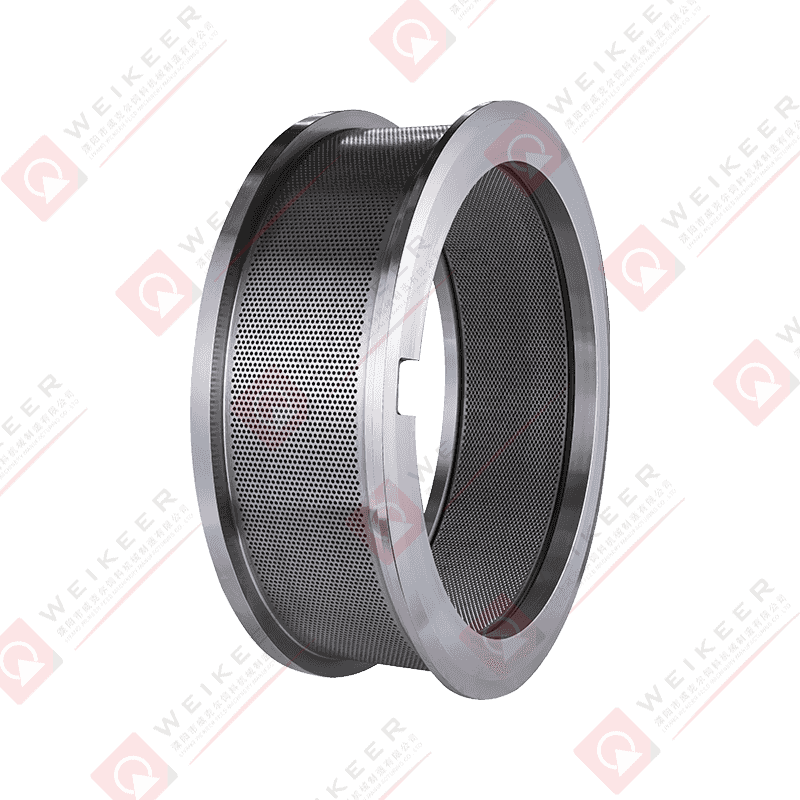

링 다이는 주로 가금류, 돼지, 소 및 기타 동물을 포함한 가축용 사료 펠렛 생산에 사용됩니다. 링 다이는 일정한 크기와 모양의 펠릿을 생산해야 하며 이는 사료의 영양가와 동물의 섭취에 매우 중요합니다. 가축 및 가금류 사료 생산에 사용되는 앵커리어 펠렛 링...
See Details
링 다이는 펠렛 공장에서 물고기, 새우 및 기타 해양 생물을 포함한 다양한 수생 생물을 위한 사료 펠렛을 생산하는 데 사용됩니다. Aquafeed 링 다이는 펠릿화 공정에서 발생하는 지속적인 마모를 견딜 수 있도록 고탄소, 고크롬강(X46Cr13)과 같은 내구성 ...
See Details
링 다이는 펠릿 공장에서 분쇄된 고양이 모래 재료를 균일한 과립으로 형성하는 데 사용됩니다. 그런 다음 이러한 과립을 건조하고 소비자가 사용할 수 있도록 포장합니다. 점토, 목재, 식물성 물질 등 다양한 재료를 고양이 모래에 필요한 작은 펠릿으로 가공하도록 설계되...
See Details
합금강 롤러 골판 마감 끝단은 독특한 기능과 용도를 갖춘 특수 구성 요소입니다. 합금강은 높은 내구성을 보장하므로 이러한 롤러는 무거운 하중 하에서 마모 및 변형에 강합니다. 상당한 무게를 견딜 수 있도록 설계되어 고강도 작업에 이상적입니다.
See Details
대각선 홈 디자인의 20CrMnTi 롤러는 고품질 20CrMnTi 합금강으로 제작된 특수 부품입니다. 이 롤러는 내구성과 접지력이 필수적인 자재 취급 분야에서 향상된 성능을 제공하도록 설계되었습니다. 롤러 표면의 대각선 홈은 견인력을 크게 향상시켜 느슨한 품목을 ...
See Details
곡선형 주름이 있는 20CrMnTi 롤러는 내구성이 뛰어난 20CrMnTi 합금강으로 제작된 고성능 부품입니다. 독특한 곡선형 디자인으로 그립력과 소재 고정력이 향상되어 생산 중 미끄러짐이 최소화됩니다. 이 롤러는 내마모성과 내부식성을 제공하여 중부하 작업에 탁월...
See Details
곡선형 주름 디자인의 GCr15 롤러는 뛰어난 강도와 내마모성으로 유명한 고품질 GCr15 베어링 강철로 제작된 특수 구성품입니다. 롤러 표면의 곡선형 주름은 그립력과 견인력을 향상시켜 다양한 자재 취급 응용 분야에 이상적입니다. 곡선형 주름으로 그립력이 향상되어...
See Details
폐쇄형 구조는 내구성을 향상시키고 재료를 더 잘 봉쇄하여 유출 위험을 줄입니다. 견고한 디자인으로 마모를 최소화하고 빈번한 유지 관리 또는 교체의 필요성을 줄입니다. 포장 중 제품의 운송 및 정렬을 용이하게 하기 위해 포장 시스템에 사용됩니다. 부하 시 안정적인 ...
See Details
끝부분이 주름진 개방형 스프링 강철 롤러는 효과적인 자재 취급을 위해 설계된 고성능 구성품입니다. 내구성이 뛰어난 스프링 강철로 제작된 이 롤러는 그립력과 견인력을 향상시키는 독특한 주름 표면이 특징이며 작동 중 미끄러짐을 최소화합니다. 개방형 설계로 설치 및 유...
See Details
움푹 들어간 표면이 있는 스프링 강철 롤러는 효과적인 자재 취급을 위해 설계된 고성능 구성품입니다. 내구성이 뛰어난 스프링 강철로 제작된 이 롤러는 그립력과 견인력을 향상시켜 작동 중 미끄러짐을 최소화하는 독특한 딤플 패턴이 특징입니다. 견고한 구조로 인해 무거운...
See Details
Add: 중국 장쑤성 리양시 다이부진 신베이 산업단지 중달리로 12호.

Phone: +86-13901498718

Tel: 0519-87306996

Email: alicezy@wkejx.com

